Fireworks Removed from Sejm Paper No. 700. Has the Fireworks Ban in Poland Been Defeated? 2026 Update
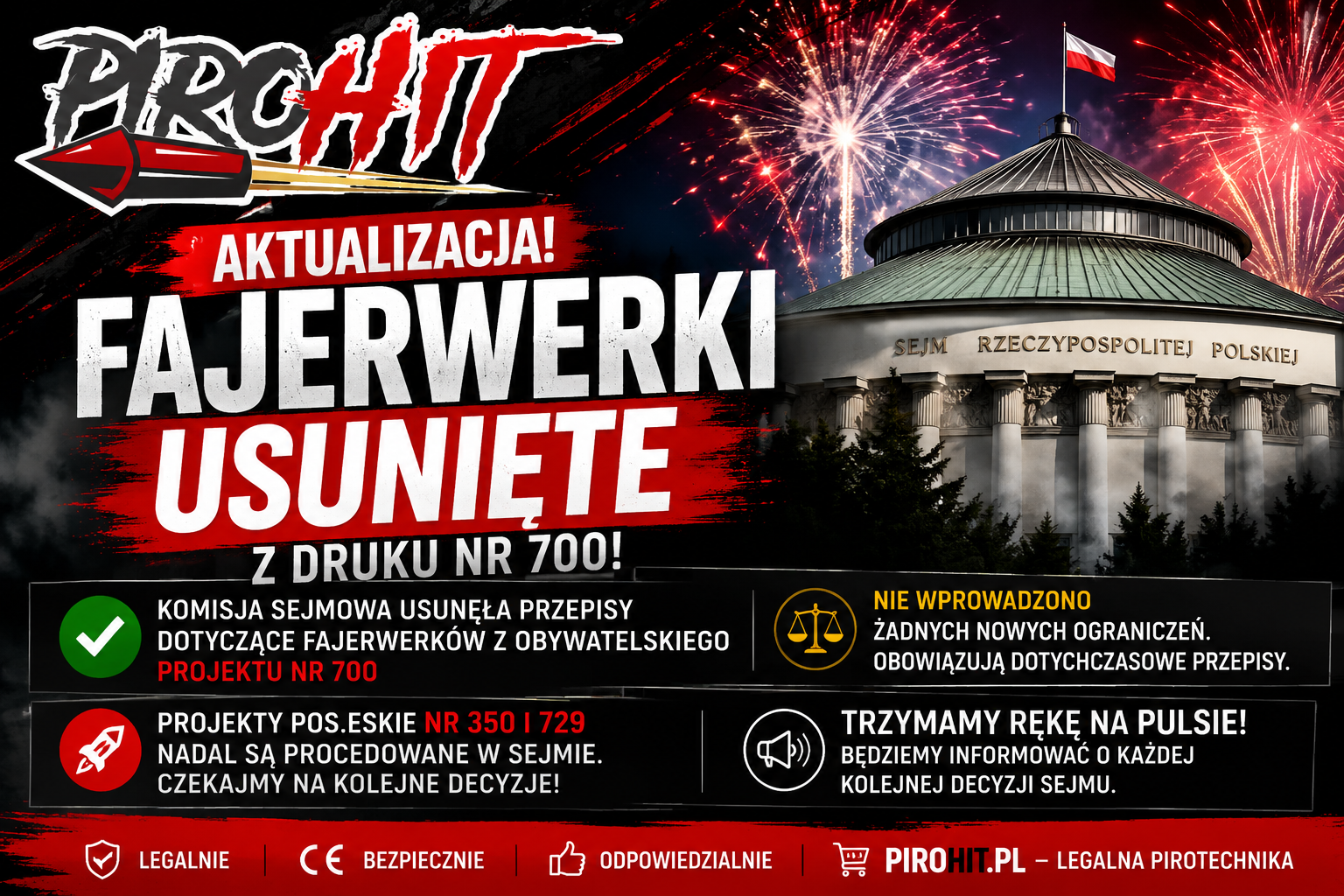
Important update on the fireworks ban in Poland
During the meeting of the Extraordinary Committee on Animal Protection held on 28 July 2026, provisions concerning fireworks and pyrotechnic articles were removed from the citizens’ bill designated as Sejm Paper No. 700.
This is very important news for the legal pyrotechnics industry, retailers, importers, companies organising professional fireworks displays and millions of responsible fireworks users. However, it does not mean that all bills seeking to restrict the use of fireworks have been abandoned.
As of 29 July 2026, no new nationwide fireworks ban has been introduced in Poland. The existing regulations remain in force, while separate parliamentary bills originally designated as Sejm Papers No. 350 and 729 are still being considered.
This article is a continuation of our earlier analysis: “Fireworks ban in Poland in 2026? The bill returns to the committee. The position of PiroHiT experts.”
Key information – status as of 29 July 2026
- Provisions concerning fireworks were removed from the citizens’ bill, Sejm Paper No. 700.
- Sejm Paper No. 700 should no longer regulate the use of pyrotechnics.
- No new fireworks ban has been passed in Poland.
- The existing nationwide regulations have not been changed.
- The separate bills No. 350 and 729 are still going through the legislative process.
- No final vote has yet taken place on the proposed rules concerning categories F2 and F3.
- At the time of publication, we are still awaiting the official version of Bill No. 700 incorporating the amendments made by the committee.
What happened in the Sejm on 28 July 2026?
On 28 July 2026, the Extraordinary Committee on Animal Protection continued its consideration of the citizens’ bill amending the Animal Protection Act and certain other acts, designated as Sejm Paper No. 700.
During the committee’s work, provisions concerning the use of fireworks and pyrotechnic articles were removed from the bill. This means that further work on citizens’ Bill No. 700 should focus on the remaining animal protection issues without regulating the fireworks market.
This represents a significant change compared with the original wording of the bill. Previously, Sejm Paper No. 700 had been cited as one of the proposals seeking to restrict the use of pyrotechnics on animal welfare grounds.
However, procedural accuracy remains important. At the time this article was prepared, the Sejm website had not yet published the full consolidated version of the bill incorporating the amendments of 28 July or the committee’s final report. PiroHiT will update the information once the official documents have been published.
Does the removal of fireworks provisions from Sejm Paper No. 700 mean the planned ban is over?
No. This does not yet mean that all legislative work on restricting fireworks has ended.
Several different bills were being considered in parallel by the Sejm. Sejm Paper No. 700 was a citizens’ bill covering a broad range of animal protection issues.
Separate parliamentary bills No. 350 and 729, which directly concern restrictions on the use of fireworks and pyrotechnic articles, are still being processed.
Removing pyrotechnics from Sejm Paper No. 700 therefore closes one legislative route that could have led to restrictions on fireworks. However, it does not automatically result in the rejection of Bills No. 350 and 729.
Bills No. 350 and 729 are still being considered
Two parliamentary bills remain particularly important for the future of the fireworks market:
- Sejm Paper No. 350 – a bill concerning restrictions on the use of firecrackers and fireworks on animal protection grounds;
- Sejm Paper No. 729 – a bill concerning restrictions on the use of display pyrotechnic articles, originally focused mainly on category F3.
Both bills were considered jointly. The committee’s work resulted in a report designated as Sejm Paper No. 2151.
Following the second reading held on 10 June 2026, the proposed amendments and the motion to reject the bill in its entirety were referred back to the Extraordinary Committee on Animal Protection.
On 17 June 2026, the committee prepared an additional report designated as Sejm Paper No. 2151-A. The next stage should be the third reading, during which the Sejm may vote on the motion to reject the bill, the proposed amendments and the bill as a whole.
Until the vote takes place, it cannot be determined whether the bill will be passed, amended or rejected. Reports suggesting that there may be no parliamentary majority for the ban should currently be treated as political assessments rather than an official voting result.
Are fireworks currently legal in Poland?
Yes. As of 29 July 2026, no new nationwide ban on the sale or use of fireworks resulting from Sejm Papers No. 700, 350 or 729 has entered into force.
Legal pyrotechnic products may still be sold and used under the existing rules, taking into account, among other things:
- the category and intended purpose of the product;
- the purchaser’s minimum age requirements;
- the manufacturer’s instructions;
- the required safety distance;
- fire safety regulations and public order rules;
- any restrictions applying in particular locations or introduced by local authorities.
The absence of a new law does not mean that fireworks can be used irresponsibly. Pyrotechnic products should come from a legal source, carry the required markings and be used strictly in accordance with the instructions.
We have explained the detailed safety rules in our guide: how to use fireworks safely.
What does this decision mean for the legal pyrotechnics industry?
The removal of the fireworks provisions from citizens’ Bill No. 700 is positive news. It shows that the arguments of businesses, experts, industry organisations and responsible pyrotechnics users are being considered in the public debate.
From the beginning, the pyrotechnics industry has emphasised that a complete or almost complete ban on categories F2 and F3 would be disproportionate.
These categories include not only loud firecrackers, but also:
- firework cakes and batteries;
- rockets;
- fountains and volcanoes;
- Roman candles;
- multi-effect sets;
- products with a reduced noise level;
- products designed primarily to produce light, colour and visual effects.
The introduction of a broad ban would affect legal retailers, importers, distributors, wholesalers, transport companies, specialist storage facilities and businesses organising professional fireworks displays.
At the same time, banning the legal market would not necessarily eliminate demand. Instead, it could increase interest in smuggled products, online sales from outside Poland or sources that do not guarantee appropriate labelling, documentation and quality control.
PiroHiT’s position remains unchanged
PiroHiT supports the responsible use of fireworks, customer education, effective penalties for dangerous behaviour and the protection of particularly sensitive locations, such as animal shelters, hospitals and areas where exceptional peace and quiet are required.
However, we oppose the introduction of a general ban that would cover entire categories of legal and certified products without properly distinguishing between their noise levels, intended use, construction and actual level of risk.
A reasonable approach should include:
- enforcing the existing regulations;
- combating illegal trade and products without the required markings;
- imposing strict penalties on people who direct pyrotechnics towards people, animals, emergency services or buildings;
- conducting educational campaigns;
- promoting products with lower noise levels;
- introducing precisely defined restrictions around particularly sensitive locations instead of a nationwide ban.
People looking for quieter effects can explore our category of low-noise fireworks and pyrotechnics with reduced sound levels.
What could happen next with the proposed fireworks ban?
Several scenarios are possible for Bills No. 350 and 729.
1. Rejection of the bill in its entirety
If the motion to reject the bill receives the required majority, the legislative work on the proposal will end.
This would be consistent with PiroHiT’s position regarding the current, excessively broad version of the proposed regulations.
2. Adoption of some amendments
The Sejm may narrow the scope of the bill, exclude category F2 from the ban, amend the rules concerning category F3, introduce additional exemptions or postpone the date on which the regulations would enter into force.
3. Adoption of the bill
If the bill receives a majority in the Sejm, it will be forwarded to the Senate.
The Senate may approve the bill, propose amendments or reject it. Once the parliamentary stage has been completed, the law will be submitted to the President of the Republic of Poland.
Only after the full procedure has been completed, the law has been signed by the President and published in the Journal of Laws could new binding regulations come into force.
Has the fireworks ban in Poland been defeated?
The most accurate answer is:
The provisions concerning fireworks have been removed from citizens’ Bill No. 700, but the separate bill seeking to restrict categories F2 and F3 has not yet been formally rejected.
This is therefore an important and positive development, but it is not the final conclusion of the entire matter.
The next key development will be the third reading and the votes concerning Bills No. 350 and 729 and the additional committee report No. 2151-A.
PiroHiT will continue to monitor the actions of the Sejm, the Senate and the President and will report every change that may be important for customers, businesses and the entire legal pyrotechnics industry.
Frequently asked questions – fireworks ban 2026
Has a fireworks ban been introduced in Poland?
No. As of 29 July 2026, no new nationwide ban resulting from the bills designated as No. 700, 350 or 729 is in force.
Does Sejm Paper No. 700 still concern fireworks?
During the committee’s work on 28 July 2026, the provisions concerning fireworks were removed from the bill. We are still awaiting publication of the official amended version.
Have Bills No. 350 and 729 been rejected?
No. Both bills are still going through the legislative process. Following the second reading, the committee prepared the additional report designated as Sejm Paper No. 2151-A.
Can category F2 and F3 fireworks currently be purchased?
No new sales ban resulting from the bills under discussion has been introduced. Sales continue under the existing rules, taking into account the product category, minimum age requirements and other applicable regulations.
Can fireworks currently be used?
No new nationwide ban has been introduced. However, fireworks must be used in accordance with the instructions, safety rules, public order regulations and any local restrictions.
Would the proposed ban apply only to firecrackers?
No. The version concerning categories F2 and F3 could also cover many firework cakes, rockets, fountains, Roman candles and multi-effect sets.
When will the final vote take place?
At the time of publication, no confirmed date should be given. The vote may be added to the agenda of one of the Sejm’s upcoming sittings.
Has it been confirmed that there is no majority for the ban?
No. The final vote has not yet taken place, so there is no official result showing the actual distribution of votes.
Reports that there is no majority for the ban are currently political assessments and should not be presented as a confirmed fact.
Official sources and documents
- Meeting of the Extraordinary Committee on Animal Protection held on 28 July 2026;
- legislative progress of Sejm Paper No. 350;
- legislative progress of Sejm Paper No. 729;
- additional committee report – Sejm Paper No. 2151-A.
Legal status and stage of the legislative process as of 29 July 2026. This article is for information purposes and will be updated following the publication of further official documents or future votes.